This article may contain affiliate links. If you buy through them, Everyday Vitality Life may earn a small commission at no extra cost to you. Learn more.
For most of one winter I slept in a room with blackout curtains, the heavy kind that block out even the streetlight that used to cut a line across the ceiling. I liked them at the time. Falling asleep was easier without any light bleeding in. But something about waking up changed too, and it took me weeks to connect the two things. Waking up in total darkness, even at a reasonable hour, felt like being pulled up from somewhere much deeper than sleep should have taken me. There was a heaviness to it, a few seconds of not being sure what time it was or even what day, before my eyes adjusted to nothing and my body had to figure out on its own that it was, in fact, time to be awake.
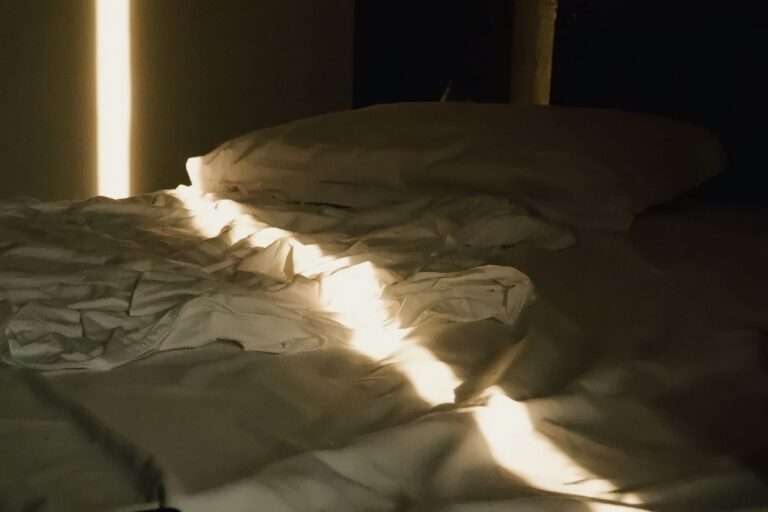
I switched the curtains out that spring, mostly by accident, because the blackout ones needed washing and I hung the old blinds back up while I waited. The first morning with the blinds, a thin seam of gray light ran along the bottom edge where they did not quite meet the sill. I woke up before the alarm, which almost never happened with the blackout curtains, and the waking itself felt different. Not sudden. Not dragged up from somewhere deep. More like the room had been quietly getting brighter around me for a while, and I had simply joined it partway through, already halfway toward being alert.
The body seems to track the light even while asleep
I do not have any device that measures this, and I am not interested in pretending I do. What I have is the repeated experience, morning after morning, of noticing that a room with even a little light finding its way in produces a different kind of waking than a room that stays black until I physically get up and open something. The body seems to be paying attention to the light even while the mind is not, tracking some slow gradient of brightness that starts to shift things toward alert well before an alarm forces the issue.
On the mornings with some light coming through, I notice the shift happening in stages. First there is a change in the quality of sleep itself, lighter, more prone to those half-waking moments where you are aware of the room without fully being in it. Then there is an actual waking that does not feel like an interruption so much as an arrival, timed loosely to whatever the light outside is doing. Compare that to a fully dark room, where the alarm is doing all the work alone, wrenching the body out of a sleep that had no warning anything was about to change.
Color as much as brightness
It is not only how much light gets in, but what kind. Early on a clear morning in October, the light through my blinds had a thin blue cast to it, almost cold, and waking up in that light felt brisk in a way that matched the temperature of the room. A few weeks later, on an overcast morning, the same blinds let in a flatter, grayer light, and waking up under it felt slower, softer around the edges, harder to place a clear boundary around where sleep ended and the day began.
Summer does something else entirely. The light arrives earlier and with more warmth in it, an amber cast that some mornings makes the whole room look like it has been dipped in something. Waking up in that kind of light does not feel like waking up cold into a demand. It feels closer to being invited, though I recognize how easily that word could sound like more than it is. It is just a difference in cast and temperature, but the body responds to it differently than it responds to the flat white of an overhead bulb switched on in the dark.
What the artificial version misses
A lamp switched on at full brightness does not ease anyone into anything. It announces.
On the darkest mornings of the year, when there is no usable daylight to speak of before the alarm goes off, I have tried simply turning on the bedside lamp as a stand-in. It works, in the sense that it produces light and I do wake up. But it is a different kind of waking, closer to a demand than an invitation. The lamp does not build gradually. It is either off or it is fully on, and the body has to catch up to that step all at once rather than being nudged along the way a slowly brightening window does it.
I have started keeping one blind cracked open even in the depths of winter, even knowing the light it lets in before seven in the morning is faint at best, more a lightening of the dark than anything I would call daylight. It still seems to matter. On those mornings the waking feels marginally less abrupt than on mornings when I have, for whatever reason, closed everything up tight. I cannot prove the difference is large. I can only report that it is there, morning after morning, small and consistent enough that I have stopped questioning it and just started leaving the blind cracked as a matter of habit.
A small, unglamorous adjustment
None of this amounts to a discovery. People have known for a long time that light and dark do something to the body’s sense of time. What surprised me was how much difference a small amount of it made, and how little effort it took to notice. I did not buy anything or change any routine. I just stopped closing the blinds all the way, and the mornings that followed felt like they had a little more room in them, a little less like being startled awake by force and a little more like arriving somewhere that had already been getting ready for me.